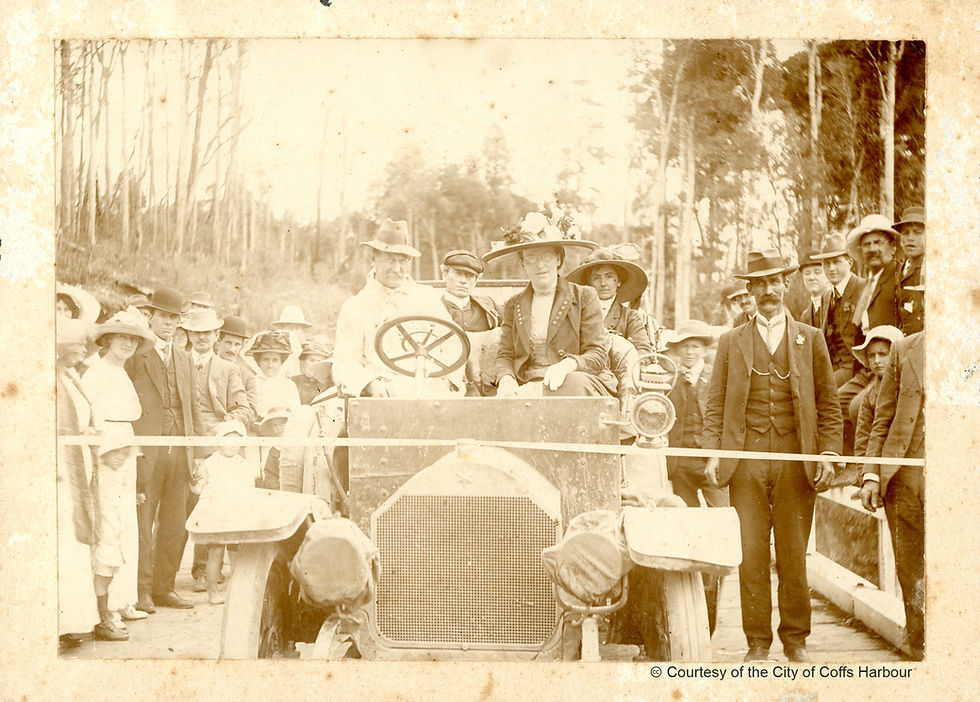
Discover the history of the
Eastern Dorrigo
The information on this page has been adapted from A Patchwork of People by local historian Beth Scaysbrook. Whilst it provides a great timeline of those who helped create the fabric of the Eastern Dorrigo community in the 1900s, it is acknowledged that the history of the area dates back well before this to the Gumbaynggirr peoples as the traditional custodians of this land.
Introduction: Settling the Plateau

The Eastern Dorrigo area, situated roughly 600 metres above sea level on the Great Dividing Range west of Coffs Harbour, is located on the traditional land of the Gumbaynggirr people. The region was first surveyed around 1886 by assistant surveyor J.N. Small, who conducted a feature survey of the Little Nymboida River and named most of the streams across the plateau.
European settlers arrived in the early 1900s, drawn by maps marking the region as the Orara Gold Fields. While early pioneers sought literal gold with limited success, they quickly discovered that the plateau's true wealth lay in its vast, magnificent forests of millable timber.
Boom, Bust and the Railway

In the earliest days, timber was painstakingly hauled off the mountain via bullock teams to the port at Coffs Harbour. This changed dramatically in 1924 with the opening of the Glenreagh to Dorrigo railway line, allowing timber to be exported directly to major cities by rail.
-
The 1950s Peak: The timber industry reached its golden age during this decade. Enrolment at Ulong School had reached close to 100 pupils, necessitating the establishment of a Central School where high school students were able to undertake supervised correspondence courses rather than travel to Coffs Harbour or be sent away to boarding school.
-
The 1970s Decline: Maintaining the mountain railway grew too costly due to frequent washouts. As logging trucks (or "jinkers" as they were called) became the preferred method of transport, the mills gradually shut down, and the railway line was permanently closed.
Heartbeat of the Plateau: Villages & Timber Mills
Ashton
The village of Ashton was named after the then Minister for Lands. It was in the area now known as Ashton Flats, a couple of kilometres west of the crossing of the Little Nymboida River on Eastern Dorrigo Way.
Bobo
Situated near the low-level traffic bridge and railway bridge crossing the Bobo River on the Ulong to Cascade Road. Little remains of Bobo today, but it was once a thriving hub featuring pine plantations maintained by the Forestry Commission and timber mills owned by the Mulhearn and Timms families.
Briggsvale
Briggsvale took its name from G.L. Briggs and Co, timber merchants and sawmillers who operated a major mill here and established an extensive private tramway.
Cascade
Situated between Ulong and Briggsvale, Cascade was named after the nearby creek. The timber mills at Cascade were operated by Eades & Co., as well as Earp, Woodcock & Co. (later Earp, Woodcock and Beveridge).
Today, the old school building serves as the National Parks and Wildlife Service's environmental education centre for Cascade National Park.
Brooklana
Like Ashton, Brooklana was a 'planned' village. Its original name was Brookland—indicative of the numerous streams in the valley—however, the name was misread because the handwritten 'd' at the end looked like an 'a'.
Gundarene
Gundarene, the original village in the Lowanna area, is situated in the Parish of Gundar, from which the village takes its name.
Lowanna
Lowanna—a word meaning 'girl' in an Aboriginal language—officially received its name in July 1917, when the Postmaster General decreed that the town, formerly known as Gundarene, would henceforth be called Lowanna.
The timber industry shaped much of the town's early footprint.
Mulhearns owned the first mill in Lowanna, which was later taken over by the Ogden Bros and subsequently by Allan Taylor & Co.
Shortly after this final acquisition, the mill tragically burnt down, prompting Allan Taylor to construct a new mill closer to Grafton Road.
Later, in the 1960s, the Australian Consolidated Industries mill was established, following the transfer of softwood milling operations from Lloyds Siding.
Lloyds Siding
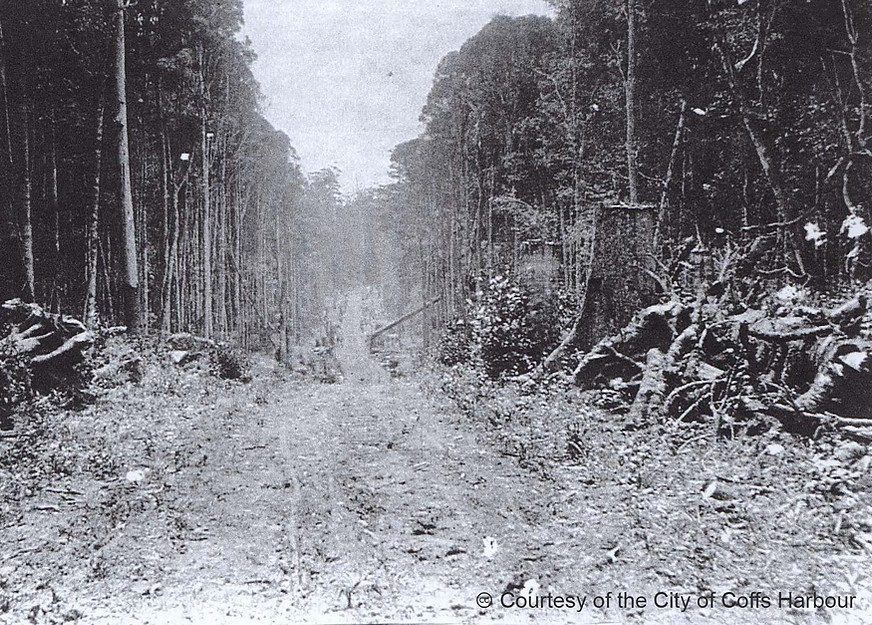
Originally known as Mulhearns Siding, this site started as a sawmill on the eastern side of Morora Creek. Later, when the Australian Consolidated Industries company opened a case mill here, the railway stop and village was renamed Lloyds Siding. These sawmills primarily processed pine harvested from the nearby plantation.
Megan
As early as 1918, Megan had a local sawmill operated by Wood, Cock, Earp & Co. Over the following decades, the community's mills underwent a series of management and ownership changes.
Megan stands as the closest village to Dorrigo. Like several other settlements on the plateau, Megan was a village laid out with plans for a township that never quite eventuated.
Moleton
Situated north of Lowanna on the Glenreagh Road, the early settlers mistook the local platypus for moles, hence the name "mole town". The local mill was established by Joseph Reid in 1925 and sold to Hudson's in 1947. The mill burnt down in 1953 and from that time the village began to dwindle.
Timmsvale
Timmsvale, located only a few kilometres north of Ulong, was named after the Timms family, who selected land in the area in the early 1900s. They established several local mills, including a unique hydro mill on the Little Nymboida River, and eventually took over a mill originally set up by the piano manufacturers, Beale & Co. Descendants of the Timms family still reside in the Eastern Dorrigo today.
Ulong
Originally named Ulong Creek, Ulong grew "like Topsy" to become the largest of the local villages, with 100 children attending the school in the late 1950s. Serving as the 'central' village of the area, it is situated 36 kilometres from Coffs Harbour and 35 kilometres from Dorrigo. The settlement supported two main timber mills: one located by the railway line—operated first by Mulhearns, later by T.B. Timms & Sons, and finally by L.E.H. Timms—and Corfe's Mill, which sat at the 'top of town'.
Community & Connection
BROOKLANA
The Drury family operated an early store here (as well as at Megan). The Allard family built a post office and telephone exchange attached directly to their home at Brooklana in the early 1900s; as the timber population decreased and access to transport improved, these local postal services were eventually transferred into Ulong.
LOWANNA
In 1910, Adolphus Paul took up a selection at Camp Creek with his wife and children, establishing a dairy farm four miles west of Lowanna called ‘Riverview’. In 1921, he built the Lowanna General Store. Following his passing in 1925, the shop was taken over by his daughter Elsie and her husband, Jack Finch. Jack ran the business until he passed away suddenly from heart failure inside the Ulong Hall during a progress meeting in September 1955.
Miss Jess Clancy operated the Lowanna Post Office and Telephone Exchange from her home until the mid-1960s, when it moved into the store with subsequent owners, including the Stathams, Barry Mannell, and the Houlihans.
MOLETON
For decades, the heart of Moleton was its postmistress, Miss Claudia Eleanor Humphrey Partridge. Miss Partridge ran the Moleton Post Office from the time of her father’s death in 1938, until its closure in 1971. Operating from a weathered timber building, Miss Partridge sorted mail, ran the manual telephone exchange, and was an independent local icon who was also a registered cattle grazier. Throughout that time, she was a much revered and respected resident.
TIMMSVALE
Mrs. Wynn worked in the Timmsvale Post Office to support her family after her husband’s leg was tragically amputated following an accident in 1931. Mrs. Wynn was related to Mrs. Hopewell of the Ulong Post Office and walked every day from her home in Ulong to Timmsvale.
Later, during the 1960s, Mick Stanley and his wife Thelma operated the local Timmsvale shop.
ULONG POST OFFICE
Mary Cameron Hopewell, a widow, and her daughter Margaret ("Peg") arrived from Scotland in 1920. Mary was appointed Postmistress of Ulong on March 17, 1924, running the post office and a lolly shop at the top end of town with Peg's assistance. In 1925, Margaret married Douglas Ward, who had arrived around 1924 to work as a butcher for Eddie Balzer.
The Wards lived near the centre of Ulong village, relocating the post office to an adjacent building around 1950. Around 1960, they converted part of their front verandah into the post office to make operating the manual telephone exchange after-hours easier. Peg would ultimately complete an incredible 50 years of continuous service to the Ulong Post Office.
ULONG - EARLY SHOPS
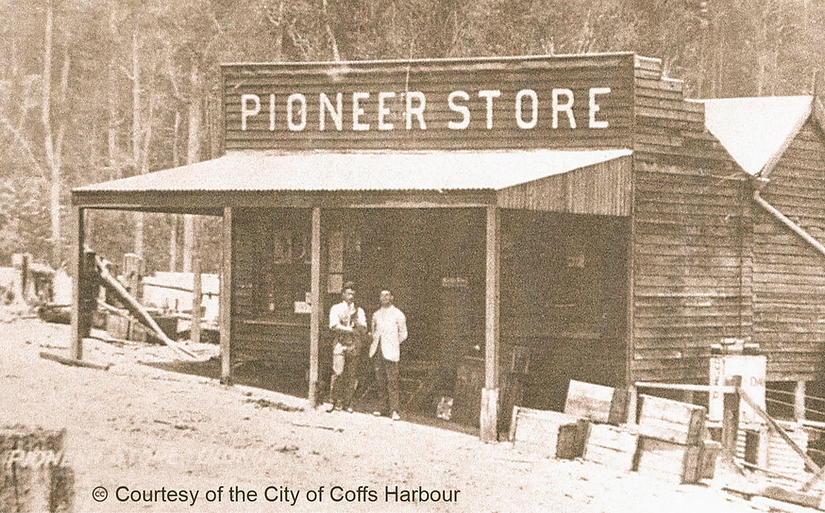
The very first shop in town was the "Pioneer Store", situated close to where the old Catholic Church stands today and operated by R.A. Howard.
The O’Hanlon Brothers subsequently opened a rival shop at the top corner on the western side of the road. In the mid-1930s, Jim Hyde bought the business from the O'Hanlons, but when the original building burned to the ground, he rebuilt the business across the road near the Ulong Hall.
Nearby, Mary Small opened another shop near the local churches, which was later run by her nephew, Peter Corfe, and his wife Betty. After the Corfes sold it, the shop changed hands several several times before it too was completely destroyed by fire around 1960.
ULONG - THE EASY STORE & THE MELODY THEATRE CO-OP
Around 1949, Bert and Mildred Easy built and operated a store near the Melody Theatre, which Mildred ran until her passing in 1974. Marilyn and Tony Statham, owners of the Lowanna shop, purchased the property and ran the Ulong Store but the business was eventually closed after proving to be uneconomical. In 1985, the Dummigan family purchased the Ulong Post Office from the Flanagan family and relocated the postal and retail shop services directly inside the historic Melody Theatre building. Within the old theatre space, Ray Dummigan operated the retail store, his daughter Jackie managed the Post Office counter, and Maureen Bowtell (nee Timms) operated an accompanying café.
Things came full circle when the original shop building was reopened as 'Mrs. Easy’s Store'. In 2010, Carol and Steve Cleary bought the business, officially naming it the Ulong General Store.
Education on the Mountain
BRIGGSVALE & CASCADE SCHOOLS
There were no schools at either Ashton or Bobo. For a brief period in the 1920s, Briggsvale operated a small school subsidised directly by the G.L. Briggs and Co. Timber Mill, but local children eventually transitioned to the nearby Cascade School or attended the small school at Morora (Lloyds Siding), which operated between 1946 and 1960.
MEGAN SCHOOL
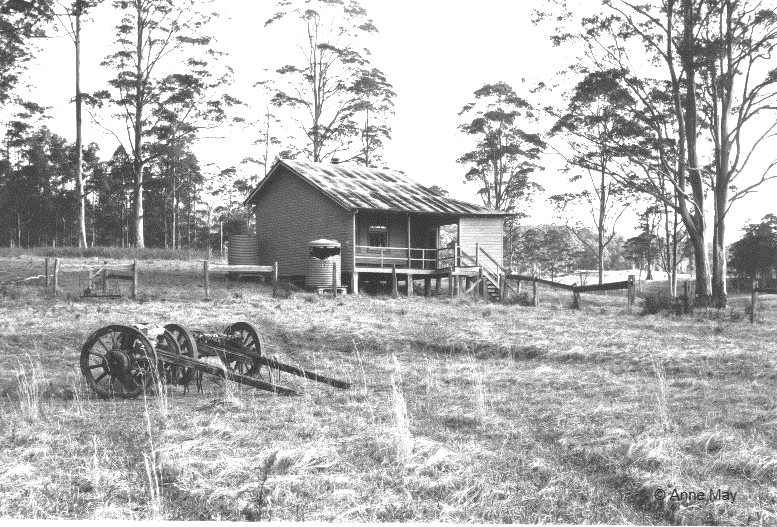
Further west, the mountain village of Megan opened its early camp school around 1910. Tenders were called in 1924 to physically move the vacant Megan camp school building to the neighbouring dairy-farming locality of Leigh, but after community representations, the plan was abandoned in 1927. The Megan School continued to serve timber families until its permanent closure in 1970, when the remaining local pupils were bussed into Dorrigo.
MOLETON SCHOOL
At Moleton, formal education began in 1928. The school was permanently closed shortly after the local mill burnt down in 1957.
TIMMSVALE SCHOOL
Timmsvale School operated as a small Provisional School from 1925 until 1941, when it was formally upgraded to a Public School. The school became a vibrant sporting and community hub, frequently competing in regional school sports days during the mid-1950s. The school ultimately closed its doors in 1970.

BROOKLANA SCHOOL
Brooklana operated as a Provisional School from May 1920 until April 1932. Following a brief closure, it reopened as a primary school from June 1936 until the end of the first term in 1950, at which point the remaining students were permanently bussed to Ulong.
ULONG SCHOOL
The historical timeline of the Ulong School began on August 11, 1910, when the first provisional classroom opened at the apex of the Ulong turnoff. Though it initially opened under the spelling "Eulong," the name was officially changed to Ulong in 1914. As the logging population expanded, a second building—the "red school"—was constructed near the turnoff to Bobo. The third and current Ulong school site was established around 1932. It became a Central School in 1959.
LOWANNA SCHOOL
The early education landscape at Lowanna began further east as a provisional school located at Gundarene in September 1912. The school endured multiple temporary closures over the next two decades, including pauses during the disruptions of 1916, 1918, and 1920. A permanent shift occurred in 1936 when the school was physically relocated close to the Glenreagh to Dorrigo railway line, officially taking on the name Lowanna and achieving full primary school status by April 1946.

About our historic landmarks...

St Andrews Presbyterian Church, Ulong
Built by Mr. O’Hanlon, the church’s construction was made possible through individual acts of generosity. Dave Smith donated the land, the timber, and the foundation block, while Mr. C. Shepherd provided the Gothic-style windows. Mr. King gifted the offering plate, Mr. Bert Easy hand-crafted the church seats, and Mrs William Hutcheson Smith (Emily May) donated the cushion for the pulpit Bible. The first services were conducted by Mr. A.D. Robertson (later Reverend), a Home Missionary stationed at nearby Coramba, who also contributed the church's reading desk and primary Bible.
On 12 October 1911, Mr. Dave Smith officially opened the doors for the first time, with a historic double baptism for infants Elma Smith and Thelma Hudson. The building served as a sacred gathering place for over sixty years and was regularly used by other Protestant denominations including the Church of England and the Methodists. It was eventually sold sometime after 1972 and today the historic building stands preserved as a private residence.
Church of the Most Holy Trinity, Ulong
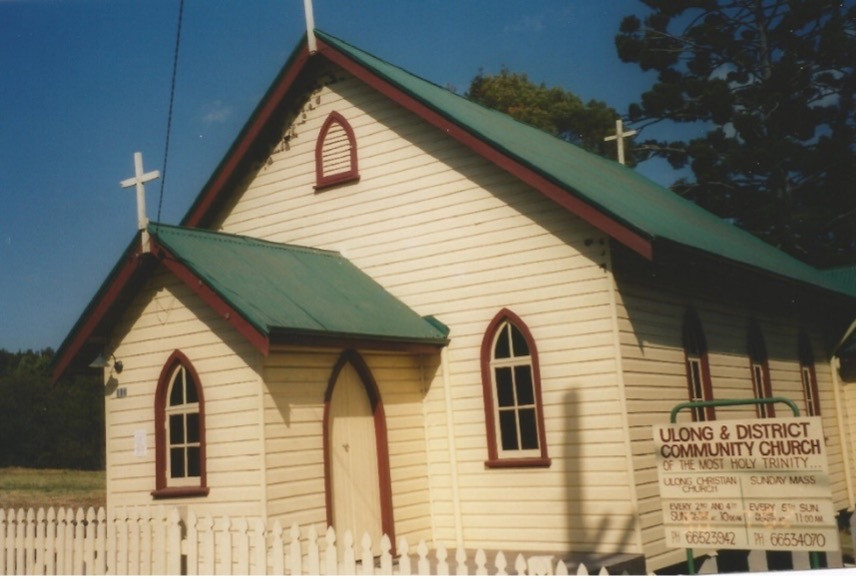
The foundations of the local Catholic Church were laid through the generosity of Mr O’Hanlon, who donated the land for its construction. Built by George Shepherd of Nana Glen, the church officially opened its doors on 4 October 1913, with the dedication ceremony led by the Most Reverend Dr. Bishop Carroll of Lismore, accompanied by Father Ryan.
For over half a century, the church served local families. When the property faced closure in the 1970s, local residents David Mulhearn and John Seccombe stepped in to purchase the building to prevent its use as a private residence. Renamed the ‘Ulong Community Church,’ they opened its doors to all denominations, ensuring it remained an active asset for the community.
In the 2020s, the historic building was sold and renovated and is now known as ‘The Ulong Chapel’, a unique accommodation and wedding venue.
St John the Evangelist Church, Lowanna
Prior to its construction, the Reverend Len Williams gathered his congregation in the old town hall to hold regular services. By the early 1930s, plans were underway and the church was built by volunteer labour for approximately £470. A rectory was also constructed behind the main building and it later served as a home for Jim and Nellie Bunt for a period of time. While the old rectory no longer stands today, the church building remains and is now a private residence.
Methodist Church, Brooklana
Before a formal church ever existed in Brooklana, the Allard family held services in their family home. In mid-1912, timber for the erection of the Methodist Church had been cut and by April 1913 the building was nearing completion. The Reverend E. Thomas officially opened the doors for the first time in October 1913.
The Story Continues with You.
Our history is a living, breathing record of our lives. Every photograph, diary entry, and memory shared helps ensure the legacy of Eastern Dorrigo is preserved for future generations.
Have an interesting story to share? Email us at hello@easterndorrigo.com.au